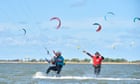
# Learning to Kitesurf in Sicily's Stagnone Lagoon: A Beginner's Guide to a Thrilling Water Sport
Kitesurfing demands respect. Unlike casual kite flying in a park, this extreme sport pairs you with a massive polyester wing capable of launching your body meters into the air. For beginners willing to embrace the challenge, the Stagnone Lagoon near Marsala in western Sicily offers an ideal training ground. The shallow, wave-free waters protected by four islands—Isola Grande, San Pantaleo, Santa Maria, and La Schola—create conditions that balance safety with genuine progression.
Week-long residential kitesurfing courses near Marsala have emerged as a popular option for Europeans seeking to master this demanding skill. The sport combines elements of windsurfing, wakeboarding, and paragliding into one adrenaline-intensive package. Instructors guide students through rigorous progressions, from mastering kite control on the beach to executing water starts and eventually cruising across open water.
The Stagnone Lagoon's geography makes it uniquely suited for instruction. The protected bay experiences consistent wind patterns without the chop and swell found on exposed beaches. Instructors can focus purely on technique rather than battling rough conditions. The shallow depth means that wipeouts, frequent during the learning phase, result in soft landings rather than dangerous crashes. Local operators have built entire training programs around these natural advantages.
Kitesurfing tourism in Sicily has grown steadily as word spreads about the region's reliable conditions. A typical week-long course costs between €600 and €1,200, depending on the operator and included amenities. Most packages combine daily instruction, equipment rental, and accommodation in nearby towns like Marsala or Trapani. Budget travelers find that southern Sicily offers better value than Mediterranean hotspots like Tarifa, Spain, or Greece's Aegean islands.
The learning curve remains steep regardless of location. Day one introduces kite control while grounded. Days two and three focus on water entry and body-dragging techniques. By day four, students typically achieve their first successful water start. Days five through seven refine directional control and introduce advanced maneuvers like the "Superman" where riders briefly leave their boards mid-air.
Fall and spring bring optimal conditions to the Stagnone. Wind speeds of 12 to 18 knots create manageable power for learners, while summer gusts can exceed 20 knots, making instruction dangerous for beginners. Winter sees reduced tourism, though experienced riders still visit during stronger wind seasons.
Sicily's kitesurfing scene exists within a broader Mediterranean adventure travel boom. Tour operators have capitalized on the region's wind resources, affordable pricing, and cultural attractions. Students often combine instruction with exploring Marsala's wine region, Mondello Beach, and the historic cities of Palermo and Trapani.
Accommodations near the Stagnone range from budget guesthouses charging €40 nightly to mid-range hotels offering all-inclusive course packages. Direct flights connect London to Palermo with Ryanair, while budget carriers link northern Europe to Catania and Palermo from €25 to €80 depending on booking timing.
Kitesurfing in Sicily delivers genuine progression without requiring tropical climates or expensive destinations. The combination of protected waters, consistent wind, shallow depths, and affordable instruction makes the Stagnone Lagoon a compelling alternative to crowded European and international spots. For travelers prepared for physical challenge and multiple wipeouts, Sicily's west coast delivers results.