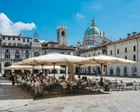
# Brescia Emerges as Italy's Most Underrated Urban Destination
Brescia ranks among Italy's best-kept secrets, a medieval Lombard city that rivals Milan's cultural depth while avoiding its crowds. Located just 40 kilometers east of Milan in Lombardy, this fortress town spent centuries as a Venetian stronghold, leaving behind Renaissance palaces, underground Roman temples, and a castle that dominates the skyline.
The city's residents display fierce pride in their hometown, actively working to shift perceptions beyond tourism's well-worn Milan-Venice corridor. Local guides like Elena navigate visitors through neighborhoods like Carmine, the gritty bohemian quarter where anarchy symbols coexist with trendy wine bars and trattorias opening for lunch service. This blend of gritty authenticity and emerging gastronomic scene defines Brescia's appeal. Unlike Venice's sanitized streets or Florence's exhausted piazzas, Brescia still feels lived-in, where locals outnumber tourists ten to one.
The city punches above its weight culturally. Two world-class art museums anchor Brescia's core: the Pinacoteca Civica and the Museo di Santa Giulia, housed in a 8th-century monastery complex. The latter contains the celebrated Winged Victory of Brescia, a Roman bronze sculpture that rivals more famous antiquities. Underground excavations reveal layers of Roman temple, Lombard settlement, and Renaissance reconstruction, visible to visitors walking through actual archaeological sites rather than behind protective barriers.
Budget travelers will appreciate Brescia's accessibility. Hotels run 40 to 60 percent cheaper than Milan alternatives. A room at Hotel Vittoria, a three-star property near the historic center, costs roughly 80 euros nightly compared to 180 euros for comparable Milan hotels. Restaurant prices follow similarly. A multi-course dinner with wine runs 25 to 35 euros in local restaurants, while Milan's equivalent costs double.
Transportation connections matter. Trenitalia regional trains link Brescia to Milan Centrale in 50 minutes, costing just 8 euros. High-speed trains to Venice take two hours. This positions Brescia perfectly as a day-trip escape from Milan's commercial monotony or as a multi-night base for exploring Lake Garda, just 35 kilometers south.
The city's castle, Castello di Brescia, anchors the northern height. Its museum traces the building's 11th-century origins through Venetian domination into Napoleonic occupation. The climb offers panoramic views across terracotta rooftops and the Brescia plains extending toward the Alps.
Food traditions run deep. Cassoeu, a soft cheese made from cow's milk, appears in every trattoria. Brescia's wine region produces Franciacorta sparkling wine, which rivals Champagne in quality but costs substantially less, averaging 15 to 25 euros per bottle in local enotecas compared to 30 to 50 euros for equivalent Champagne.
For travelers fatigued by Italy's mainstream circuit, Brescia delivers everything Italian tourism promises: history, culture, food, wine, and walkable urban atmosphere. The difference lies in discovery. You arrive first. The crowds come later.