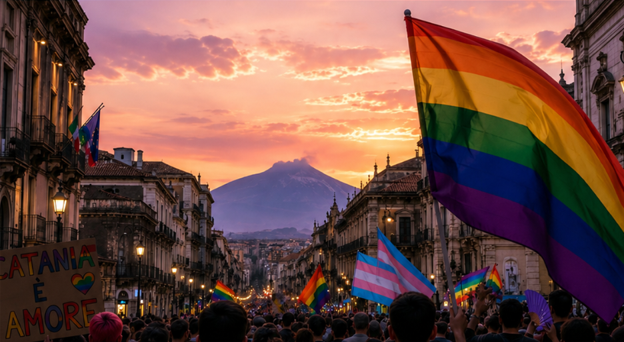
Catania, Sicily's second-largest city, offers travellers far more than its famous Mt Etna volcano and Baroque piazzas. A grassroots tourism initiative centered on LGBTQIA+ experiences and community history has emerged, reshaping how visitors explore the city's authentic cultural landscape.
Ostello degli Elefanti, a hostel in central Catania, partnered with the city's LGBTQIA+ community to develop Queer Catania, a travel experience that moves beyond postcard scenery to uncover the city's queer history, activism, and contemporary culture. This collaboration represents a growing trend in European travel where local hospitality businesses align with marginalized communities to create meaningful, non-extractive tourism products.
The initiative matters for several reasons. Traditional travel guides and mainstream tourism operators in Catania typically emphasize Mt Etna's geological drama, the ornate Baroque churches of Via Crociferi, and Vucciria Market's culinary theatre. These landmarks deserve attention, but they obscure the lived experiences of LGBTQIA+ residents and visitors seeking authentic cultural connection. Queer Catania fills this gap by centering community voices and local knowledge.
Ostello degli Elefanti operates as a budget hostel option in the heart of the city, positioning itself as an accessible entry point for budget travellers and backpackers exploring Sicily. Hostels increasingly function as community anchors rather than merely transaction-based accommodation providers. By embedding itself in local LGBTQIA+ networks, the hostel creates a competitive advantage while supporting grassroots activism and cultural preservation.
The Queer Catania framework likely includes guided walking tours through neighborhoods where LGBTQIA+ culture thrives, conversations with local activists and artists, and access to spaces that matter to the community. This approach contrasts sharply with "voluntourism" models that can be exploitative. Instead, Ostello degli Elefanti appears committed to economic benefit-sharing and community agency.
Sicily itself has transformed into a queer travel destination in recent years. Cities like Palermo and Messina have developed LGBTQIA+-friendly hospitality sectors. Catania's initiative extends this momentum by documenting and celebrating the city's own queer urban memory, which includes decades of Pride celebrations, underground bar culture, and resilience against social conservatism in a traditionally Catholic region.
For budget-conscious LGBTQIA+ travellers and allies, Catania now offers something distinct from typical Mediterranean package tourism. The city remains affordable compared to Venice or Rome, with street food meals averaging 5-8 euros and hostel beds typically under 25 euros per night. Adding curated queer cultural experiences to this cost structure makes Catania an increasingly attractive destination for culturally conscious travellers seeking connection.
This model also matters for how Sicily positions itself within European tourism. Rather than competing solely on natural beauty and historical monuments, Catania can market itself as a destination where travellers actively participate in community life and support social movements. This appeals particularly to younger, socially aware demographics that prioritize ethical travel spending.
The partnership between Ostello degli Elefanti and Catania's LGBTQIA+ community demonstrates how independent hostels and small hotels can drive meaningful tourism transformation without requiring massive corporate investment or top-down development schemes. Community-led tourism creates economic opportunity while preserving cultural authenticity, a balance many destinations struggle to achieve.